
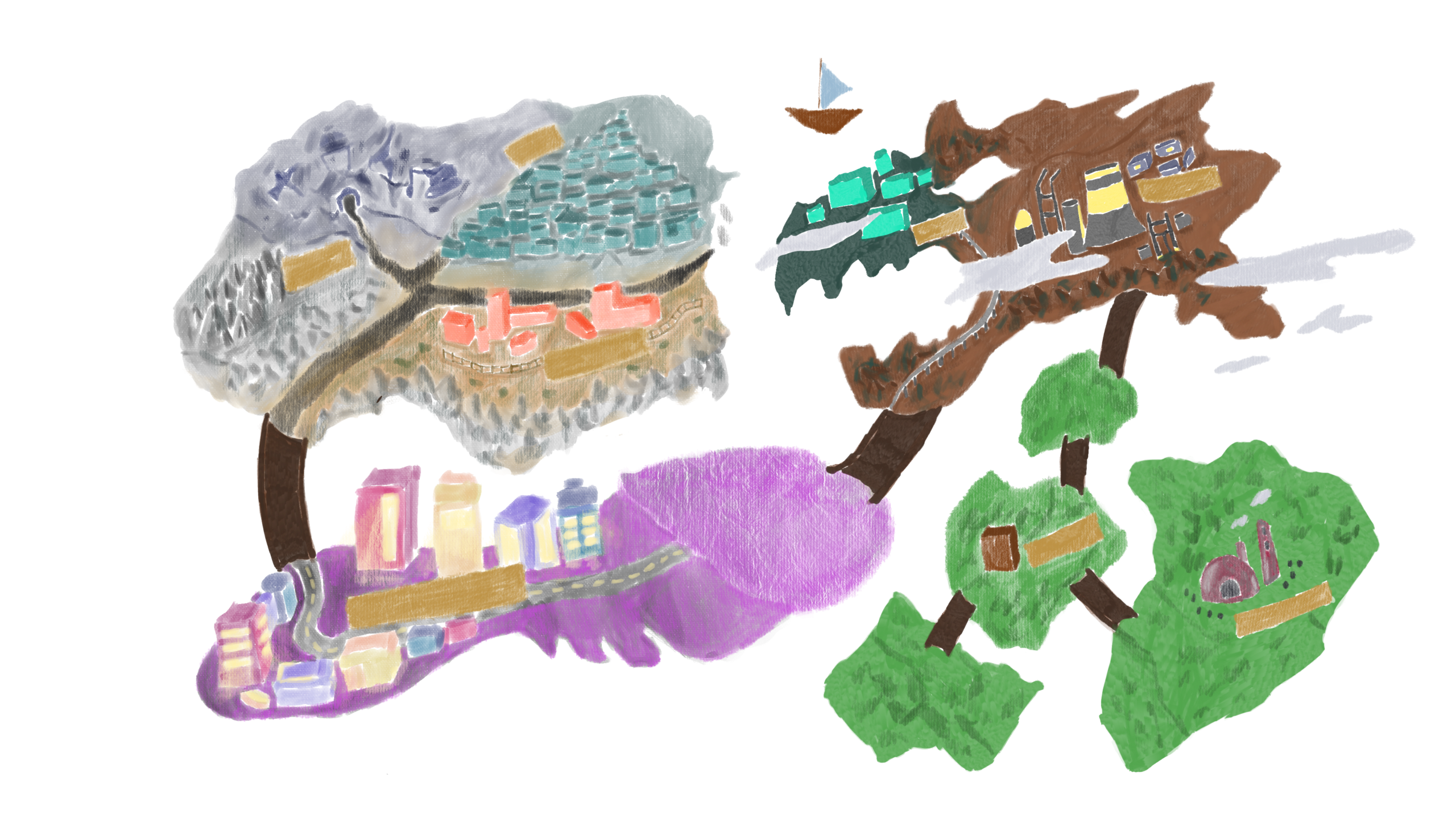
Not long after the official outbreak of COVID-19 in Europe, I took over co-running Otic Radio, a student radio project at my school. J, who managed the program, and I were invited by a radio collective from another art school and found ourselves on a train heading to Bremen. We were lucky to get a table seat with no one else booked, so we sat facing each other and chatted for a while before each sinking into our own private thoughts. I fixed my gaze on the rapidly passing scenery outside the ICE window. How long had it been? Suddenly, I turned my head to look at J. She was smiling and told me to check the footage she had just captured on my camcorder. The footage showed me gazing out of the window. “Whoa, I had no idea. When did you even film that?” “Keep watching.” The camcorder screen zoomed in, slowly settling close to my pupils. The scenery outside the window was moving fast; it was impossible to fix my gaze on any single scene, so my eyes darted around frantically, seemingly lost. My gaze was roughly crushed by the train’s speed and aimlessly wandered, desperate to capture every single frame of information. Like a young obsessive person anxious about being left behind, it is filled with a desire to absorb information, yet its frantic and scattered movements seem incapable of settling anywhere. What are you searching for so desperately? Do you think you are Sauron’s Eye?[1] My eyes grow weary from constant movement, so I try to relax the tension between my brows and fade to black. When I open my eyes again and watch the world, time inside the train has stopped.
[1] Sauron’s Eye
Sauron, one of the central antagonists in J.R.R. Tolkien’s The Lord of the Rings, is depicted in the film adaptation as a giant, fiery eye. In the original text, “the Eye of Sauron” is not a literal eye but rather a metaphorical representation of Sauron’s will and perception. Fandoms often interpret this as a panoptic form of “the all-seeing eye that observes everything from afar.” Michel Foucault, in Discipline and Punish, expanded Jeremy Bentham’s concept of the Panopticon to describe a modern mechanism of surveillance—a spatial and social structure that compels individuals to internalize control and regulate their own behavior.
Among the theories of modern physics, Einstein’s special theory of relativity is considered a great discovery and is introduced alongside a thought experiment involving a railway. According to this theory, the speed of light remains constant in all inertial frames of reference, and the perception of time and space within a moving object changes according to its velocity. Therefore, two spatially separated events cannot be said to occur simultaneously in an absolute sense. The length of an object contracts in the direction of its motion, and time flows more slowly within it. An observer standing next to a train would measure the train’s length as shorter and the time interval as longer than a passenger inside the train. These effects only appear when an external observer views a moving object. The observer never perceives the spatial changes and the time delay occurring in the moving object. If two spacetime frames can be causally connected, the sequence of events can be maintained in all reference frames.
While it is unclear whether this background directly influenced the conception of the theory of relativity, in 1905, when Einstein published his papers on relativity, he was working at the Swiss Patent Office in Bern. At that time, Switzerland was actively constructing a railway network, and many patent applications were submitted for technology to synchronize the clocks installed at each train station. The relationship between a stationary person (external observer) and a person moving at constant velocity in a straight line (internal observer on the train) shifts from being a relationship between observers to being a relationship between their respective reference frames—the clocks they possess.
… (puff-puff-chugga-chugga-clack-clack-clang-clang-choo-choo-toot-toot)
The train bound for Bremen was racing along the track far from the station. It is impossible to tell if any villagers living near the railway were admiring the train from afar. Since the dawn of the digital era, smartphones have always been in our hands, much like samurai who never parted with their swords even while sleeping. When an impressive scene appears before our eyes, we immediately raise our phones to capture it; *click* for a still image, or *whirrr* for a moving image. Although we used a relatively artistic and old-fashioned medium compared to a smartphone, the camcorder captured my image gazing out of the train window. Einstein’s railway experiment uses the temporality experienced by observers inside and outside the train as its motif. And I am contemplating the temporality possessed by my own eyes, as captured by the camcorder from the time outside the camcorder. If the relativity of reference frames can be extended to the senses that perceive social structures and gender dysphoria, how might we interpret that time dilation?
Lacan’s concept of the Other positions the subject within a symbolic realm that transcends the subject itself, enabling access to a knowledge beyond language held by the unconscious; quantum physics reveals that the truth of singular reality only comes into being when observed, emerging from the indeterminacy of overlapping possibilities; alongside the special theory of relativity mentioned earlier and simulation theory as applied to game actors, these frameworks all describe a condition in which perception constructs reality.
From my childhood, when I knew nothing about any theory, from the short essays I wrote on the subject in school to the blog posts I’ve maintained for over fifteen years, metaphors describing ‘the gaze that observes one’s own body from outside it, as a third party watching the body placed there’ were often described. These incidents most often surfaced when revealing my body to others, or when giving or receiving sex roles (the most reliable way to confirm physical sensations are functioning).
I couldn’t pinpoint where that strange feeling came from, whether during sex, in a moment of sexual harassment, or when being spycammed by people met through a dating app. It is the feeling of being observed from a bird’s-eye view, gazing at the body, rather than the immediate physical presence of the body engaged with the other person. Though it felt disgustingly long, that time might have been valuable as a pre-transitional stage before the 1.5th stage of transition (if we accept the epistemological shift after ‘recognition’—not hormone replacement therapy or operation—as a secondary transition)[2]. It wasn’t until my late twenties that I found some small comfort in condensing the compelling reasons for repeatedly distancing myself from a specific identity into a single sentence. “This body is not mine.” The observer looked down at the woman’s body, soaked in pain and fear (or what a woman ought to feel), and was flustered that it wasn’t as traumatic as expected. So they repeatedly apologized for not actively saving you. Sexual shame stemmed not from physical sensation but from the sensation of being watched. It was impossible to feel pure compassion for my own body. It was always feminist compassion directed at ‘womanhood’, not me.
[2] Secondary transition
(..) Like the slave narrative, the classic transsexual autobiographical narratives have three parts: an account of pre-transitional feelings about identity, the “middle passage” of transition, and post-transitional life experiences in a new gender.” Susan Stryker, “When Monsters Speak” 38p, Duke University Press, 2024
The discourse of the physical observer becomes the transgender body observing the designated body shell from outside the body. The establishment of a reference frame shifts to a social discussion about whether the temporality between self-revelation (coming out) and being recognized by others (passing) can be coordinated. The exploration of this parallel temporality — never aligning — led to a strategy of not viewing one’s own existence as an insult to women. This strategy emerged from the problematic consciousness of a female feminist with a history as a relentless rape victim and the ontological mindset of an FTM transgender feminist who cannot feel agency in the female body. My fear of identifying stems from the concern that maintaining a cynical attitude towards the concept of the innate female body, or failing to feel a sense of belonging, might eliminate the prospect of feminist queer solidarity.
I recall Butler’s assertion that the ideology operates before the physical reality of a body that designates gender. This concerns how gender is assigned differently according to state sovereignty, systems of law, and generational and historical timelines, not that gender itself is an ideology. But today ‘gender ideology’ has been distorted into the malicious far-right political rhetoric that “gender itself is ideology.” As Butler was aware of the contemporary context in which the term ‘gender ideology’ is being used as a strategy in far-right narratives, in a conversation with the author of Who’s Afraid of Gender? (2024), they pointed out the phenomenon whereby not only today’s transphobic, anti-gender movements and anti-feminist authoritarians such as Viktor Orbán and Putin utilize the term ‘gender ideology’, but also some trans theorists and even ‘left-wing comrades’.
“(..) When we think about that act of sex assignment, of course, it’s a material, a social act; if we’re going to remember Marx, that’s a material practice; a sex assignment happens in institutions by authorized individuals according to legal documents, which, as we know, is sometimes contradictory. As Paisley Currah has pointed out, depending on which legal regime you’re in, your sex is going to be assigned differently, and maybe even in a contradictory fascio. So sex assignment is a moment of social power, of classificatory power. It doesn’t decide once (and for all you know) how best to name that body is a provisional assignment, that is taken up over time, is lived out, or fails to be lived out, meets up with queer failure and some other movement becomes possible. So if we make it into a temporal issue, which it is for all of us, even people who are super happy with their sex assignment. (..)” [3] Who’s Afraid of Gender, Judith Butler and Jack Halberstam in Conversation (uploaded on 2024.6.4)
Proposing a trans-nonbinary perspective that acknowledges the conflict between viewing a trans identity as political performativity and the ideological structure through which the body is perceived opens up communication possibilities for both transgender and nonbinary individuals. Although non-binary declarations may sometimes appear to trivialize queer identity, I agree with Butler that this is not the only argument for viewing gender as a neoliberal construct. In fact, identity can paradoxically enable us to briefly dwell in the present, precisely because everyone experiences time differently. When we recognize generational differences, inevitably varying in the moments represented and the ways they are represented, we begin to understand what it means for a body to exist in time, before ideology. ‘Why does that elderly person feel so young?’, ‘Why does that elderly person feel so young?’, ‘Why does that child seem like an old soul?’ Rather than viewing queer identity through terminology and identity, let us try to understand it through temporal phrasing. Not as lesbian writer Kathy Acker or non-binary theorist Judith Butler, but why does that person seem like a rebellious boy? Why, Despite the pressure of generational discourse to constantly observe shifting contemporaneity and the absolute, irreversible gravity of time, why can a 69-year-old theorist still position themselves within the non-binary category in the present moment? What does it mean to look at an image of a boy rather than a ma or pa?
– written in 2025